Largest Contentful Paint (LCP)
How fast it loadsTime until the main item on screen — usually the top photo or headline — has appeared. Aim for 2.5 seconds or less. Oversized top images and slow hosting are the usual culprits.

Speed Optimization
Website speed optimization for Milton businesses: why your site feels slow on a phone, what Google measures, and how we get it passing Core Web Vitals.
You open your own site on a good connection and a recent computer, with half of it already stored by your browser. A new customer, by contrast, opens it for the first time on an older phone, on mobile data, perhaps on the GO train or in a parking lot off the 401. Those are very different experiences, but Google measures the second one.
Speed matters twice. People abandon pages that take too long, so the inquiry is lost. And Google uses real loading data from Chrome users in its rankings, so a slow site is also shown less often. That is why website speed optimization is one of the few jobs that improves both at once.
Search demand
Google’s Canadian suggestions. The symptom comes first; the technical terms come later.
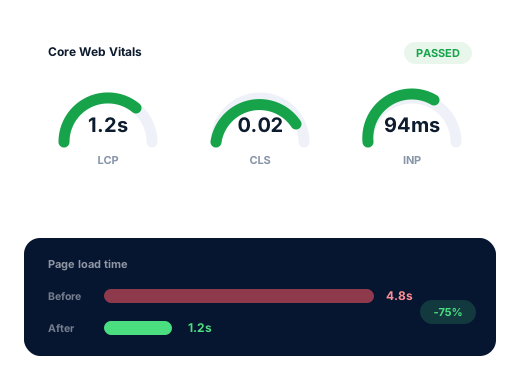
PageSpeed Insights shows a score out of 100 at the top, and it is tempting to chase it. However, that score comes from a simulated test. What Google uses for ranking is the real-user section, which reports whether actual visitors passed the three measures. So we aim for that, and treat the score as a rough guide. For example, this site’s own home page scores in the high 90s on mobile.
Where the time goes
In fact, in most small business audits, two or three of these account for nearly all the delay.
A picture straight from a phone can be several megabytes, shown in a space a few hundred pixels wide. So resizing and modern formats often halve the page weight.
Visual builders make editing easy by adding a lot of code to every page. As a result, builder-made home pages with thirty or more scripts are common.
Chat widgets, pop-ups, social feeds, several tracking tags and embedded maps each add downloads. Some earn their place, but many were added once and forgotten.
On an overloaded shared server the first response alone can take over a second, and nothing on the page can make up for that.
Without it, every page is rebuilt from scratch for every visitor. With it, however, most visitors get a ready-made copy almost instantly.
What Google measures
Measured from real visits by Chrome users over the previous 28 days. A page passes when three in four visits meet all three thresholds in Google’s Core Web Vitals guide.
Time until the main item on screen — usually the top photo or headline — has appeared. Aim for 2.5 seconds or less. Oversized top images and slow hosting are the usual culprits.
Time between a tap and the page reacting. Aim for 200 milliseconds or less. Heavy scripts from chat widgets, sliders and tracking tags are normally to blame.
How much the page jumps while loading — the effect that makes you tap the wrong thing. Keep it under 0.1. Above all, images without set sizes and late-loading banners cause it.
The work
Real-user and lab measurements of your key pages recorded before any website speed optimization starts, so the improvement can be proven.
Every image resized for its space, compressed, converted to WebP where supported, and loaded only when needed.
Unused plugins removed, non-essential scripts delayed, and also fonts served from your own site.
Page and browser caching set up to suit your host, so repeat visits are near-instant.
If the server is the limit, we show you the evidence and the options. Still, moving is your call.
Lab results rechecked straight away; real-user data, which updates over 28 days, reported when it does.
Done carefully
Rules we keep for every client, written down so you can hold us to them.
A faster site will not rescue weak content, and a perfect score is not needed to rank.
Speed is one ranking signal among many, so its biggest benefit is that fewer visitors give up. We will tell you when a site is fast enough and your money is better spent on content or your Google profile.
Ask us about your business
How we work
How a Milton business goes from overlooked to the first name on the map, in four clear stages.
We review your website and Google listing and check your rankings from several spots in Milton, then show you where the gaps are.
We pick the searches worth winning near you and give each one its own page, so your pages never compete with each other.
Listing improvements, site fixes, new pages and directory work, tackled in the order that brings the biggest gains first.
Every month: rankings, visits, calls and messages, plus the plan for next month in plain English.
Questions
Search for PageSpeed Insights, enter your address and choose the mobile tab. Then read the real-user section at the top first. If it says there is not enough data, use the lab results below as a guide.
Main content visible within 2.5 seconds on a phone, a response to taps within 200 milliseconds, and nothing jumping around as it loads.
It can help when you are close to competitors. However, the surer gain is more visitors staying long enough to get in touch.
One to two weeks for most small sites. Google’s real-user figures are a 28-day average, so the official result shows about a month later.
Website speed optimization is quoted as a one-time job in Canadian dollars after an audit, because sites vary so much.
Works best alongside
Each service supports the others: a fast site helps rankings, rankings lower ad costs, and a complete listing lifts everything.
See all servicesFurther reading
Practical guides on the same subject, written for Milton business owners.
Each can be booked on its own; most Milton clients begin with one.
Milton searches differently for every trade, so each of these pages has its own research.
Ask for a free audit: your rankings from Old Milton to the new south end, the competitors ahead of you, and the first fixes worth making.
Get your free SEO audit